


The Digital Classroom Revolution: An Introduction to the Global Edtech Industry
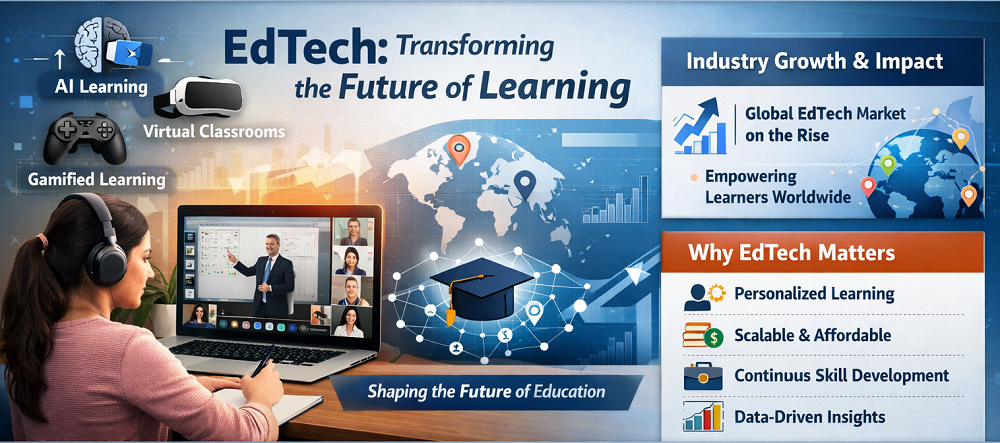
In the 21st century, the centuries-old model of education is undergoing a profound and technology-driven transformation, moving beyond the physical walls of the classroom to a more accessible, personalized, and engaging digital realm. This revolution is being led by the dynamic and rapidly expanding Edtech industry, a sector dedicated to the development and application of information technology to improve teaching and learning. "Edtech," or educational technology, is a broad and all-encompassing term for the hardware, software, and platforms designed to enhance educational outcomes. It spans a vast spectrum, from the digital whiteboards and tablets used in a modern K-12 classroom, to the sophisticated Learning Management Systems (LMS) that serve as the central nervous system for universities, and the direct-to-consumer mobile apps that allow individuals to learn a new language or a professional skill on their own time. By leveraging the power of the internet, mobile devices, and artificial intelligence, the Edtech industry is breaking down the barriers of time and place, democratizing access to quality education, and creating a new paradigm of lifelong learning for a global audience.
The Edtech industry serves a diverse range of sectors, each with its own unique needs and solutions. The K-12 sector is a massive part of the market, where technology is being used to augment and, in some cases, replace traditional teaching methods. This includes the use of interactive whiteboards, laptops or tablets for every student (one-to-one computing), and a vast array of educational software and games designed to make learning subjects like math and science more engaging. The higher education sector has been a major adopter of Edtech, particularly through the use of Learning Management Systems (LMS) like Canvas and Blackboard, which provide a central online hub for course materials, assignments, and communication. The rise of Massive Open Online Courses (MOOCs) from platforms like Coursera and edX has also revolutionized university-level learning, offering courses from top institutions to a global audience. The corporate learning and professional development sector is another huge market, where companies use e-learning platforms to train their employees, ensure compliance, and upskill their workforce in a scalable and cost-effective manner. Finally, the direct-to-consumer (D2C) segment, which includes language learning apps, online tutoring platforms, and skill-based learning sites, caters to individual lifelong learners.
The technology at the heart of the Edtech industry has evolved significantly. The initial wave of Edtech was focused on digitizing existing content—turning textbooks into e-books and lectures into video recordings. While valuable, this was largely a substitution of one medium for another. The modern era of Edtech is defined by interactivity, personalization, and data-driven insights. Learning Management Systems (LMS) are the operational backbone, providing the platform for delivering and managing digital learning content. Interactive learning tools, such as digital simulations, virtual labs, and gamified quizzes, create a more active and engaging learning experience. The most profound recent development has been the infusion of Artificial Intelligence (AI) into the learning process. AI is being used to create adaptive learning paths, where the difficulty and content of the material automatically adjust to a student's individual pace and performance. AI-powered tutors and chatbots can provide instant feedback and support, and AI can be used to analyze learning data to provide educators with deep insights into which students are struggling and where the curriculum can be improved.
Ultimately, the goal of the Edtech industry is to make education more accessible, affordable, and effective for everyone. It breaks down geographical barriers, allowing a student in a remote village to access a world-class education that was previously only available to those in major urban centers. It offers a level of flexibility and convenience that traditional education cannot, allowing working adults to upskill on their own schedule. It promises to create a more equitable and personalized learning experience, moving away from the "one-size-fits-all" model of the traditional classroom towards a student-centric approach where every learner can receive the individualized support they need to succeed. By harnessing the power of technology to augment the work of great teachers and to empower individual learners, the Edtech industry is not just building new tools; it is building a new future for education, one that is more open, more engaging, and more attuned to the needs of the modern world.
Top Trending Reports:

 English
 Arabic
 French
 Spanish
 Portuguese
 Turkish
 Dutch
Dutch
 Italiano
 Russian
 Romaian
 Portuguese (Brazil)
 Greek
Greek