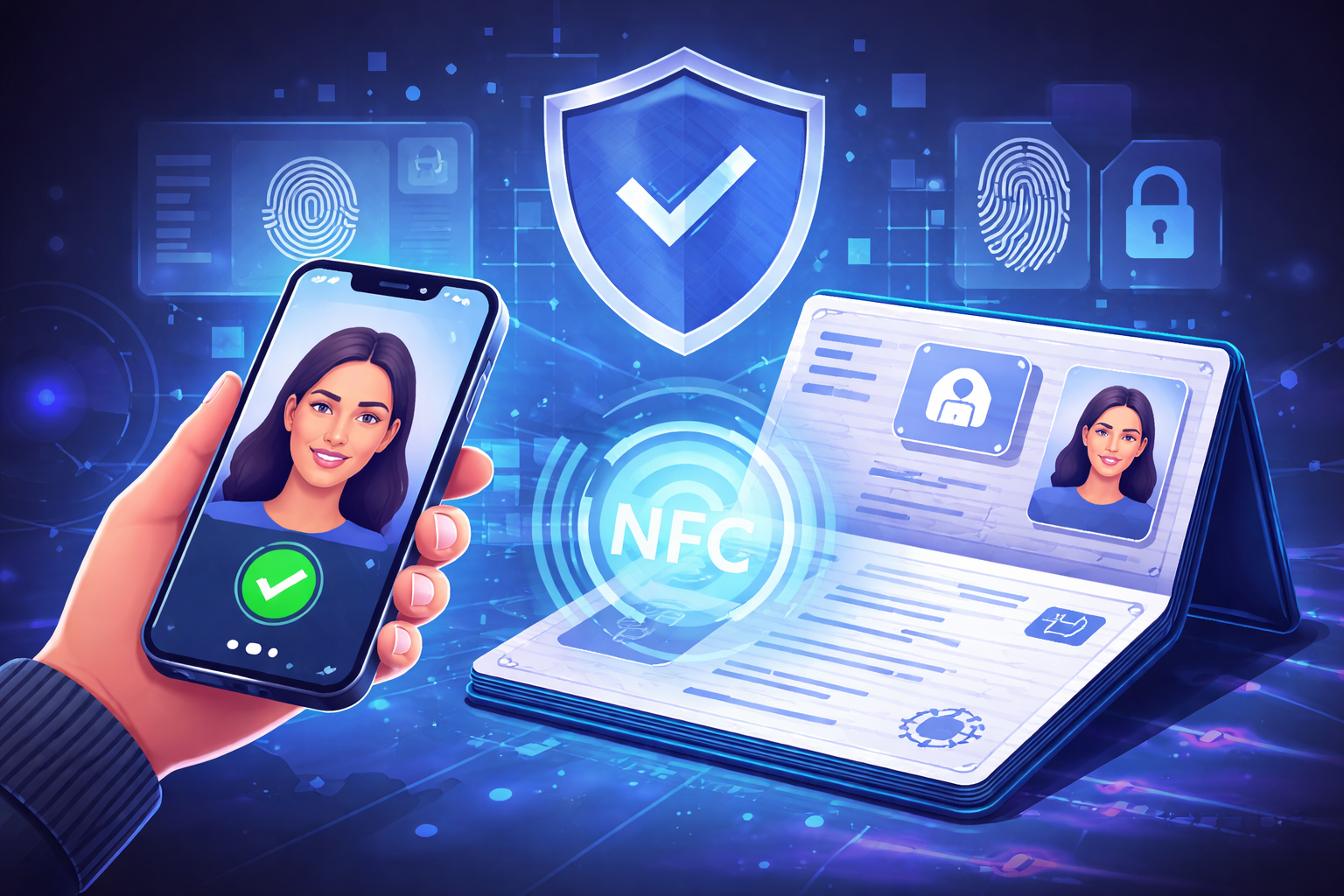
In today’s digital world, where cyber threats and identity fraud are rapidly increasing, businesses must adopt advanced technologies to ensure secure and seamless user verification. Two of the most powerful solutions transforming identity verification are facial biometric authentication and NFC (Near Field Communication) identification. These technologies not only enhance security but also improve user experience, making them essential for industries like banking, fintech, travel, and e-commerce.
What is Facial Biometric Authentication?
Facial biometric authentication is a cutting-edge technology that uses a person’s unique facial features to verify their identity. It works by capturing a live image or video of the user and comparing it with the stored data in a database or an identity document. Advanced algorithms analyze key facial points such as the distance between eyes, nose shape, and jawline to ensure accuracy.
This method is widely used in KYC (Know Your Customer) processes, enabling businesses to onboard users remotely without physical verification. With the integration of AI and machine learning, facial recognition systems can now detect spoofing attempts, such as photos, videos, or masks, ensuring a high level of security through liveness detection.
Understanding NFC Identification
NFC identification is another revolutionary technology that enables secure, contactless data exchange between devices. It is commonly used in ePassports, smart ID cards, and contactless payment systems. NFC allows mobile devices to read encrypted data stored in a chip embedded within identity documents.
When used for identity verification, NFC technology ensures that the data extracted from the document is authentic and tamper-proof. This adds an extra layer of security to the verification process, making it highly reliable for industries that require strict compliance with regulatory standards.
Benefits of Combining Facial Biometrics and NFC
The combination of facial biometric authentication and NFC identification creates a robust and fraud-resistant verification system. Here are some key benefits:
- Enhanced Security: NFC ensures document authenticity, while facial biometrics verifies the user’s identity.
- Faster Onboarding: Users can complete verification within seconds using their smartphones.
- Fraud Prevention: Advanced checks prevent identity theft, deepfakes, and spoofing attacks.
- Regulatory Compliance: Helps businesses meet global KYC and AML requirements.
- Seamless User Experience: Contactless and user-friendly process improves customer satisfaction.
Use Cases Across Industries
These technologies are widely adopted across multiple sectors:
- Banking & Fintech: For secure digital onboarding and transaction authentication.
- Travel & Hospitality: For ePassport verification and seamless check-ins.
- Telecom: For SIM card registration and customer verification.
- E-commerce: For secure account creation and fraud prevention.
Conclusion
Facial biometric authentication and NFC identification are redefining the way businesses approach identity verification. By combining these technologies, organizations can achieve a perfect balance between security, speed, and user convenience. As digital transformation continues to grow, adopting these advanced solutions is no longer optional but essential for staying competitive and secure in the modern landscape.




 English
 Arabic
 French
 Spanish
 Portuguese
 Deutsch
 Turkish
 Dutch
Dutch
 Italiano
 Russian
 Portuguese (Brazil)
 Greek
Greek